
Chatarra
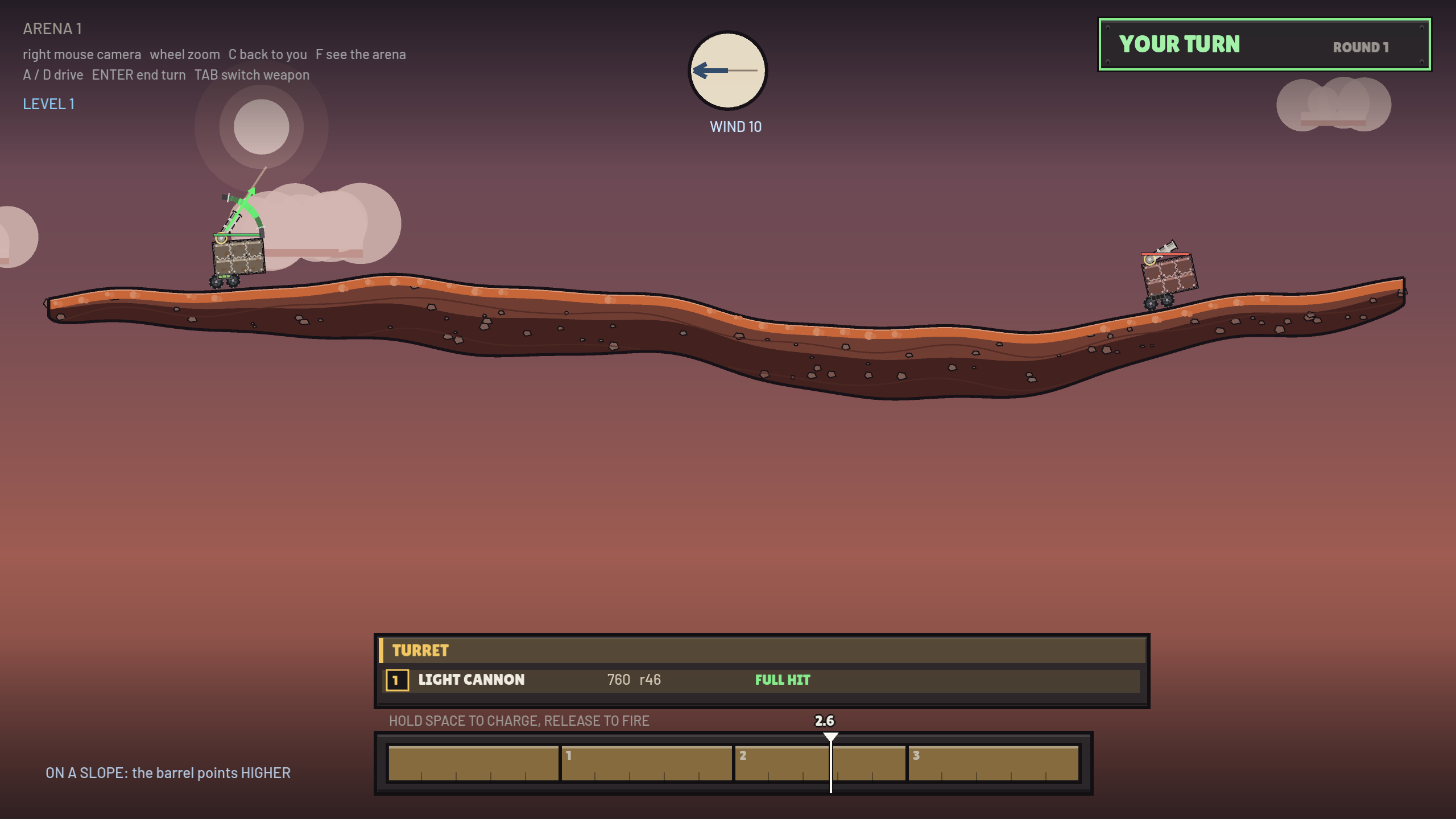
Two rigs. One thin, floating island each. No timer and no reflexes — just the angle, the wind, and what you decided to bolt onto your machine three fights ago.
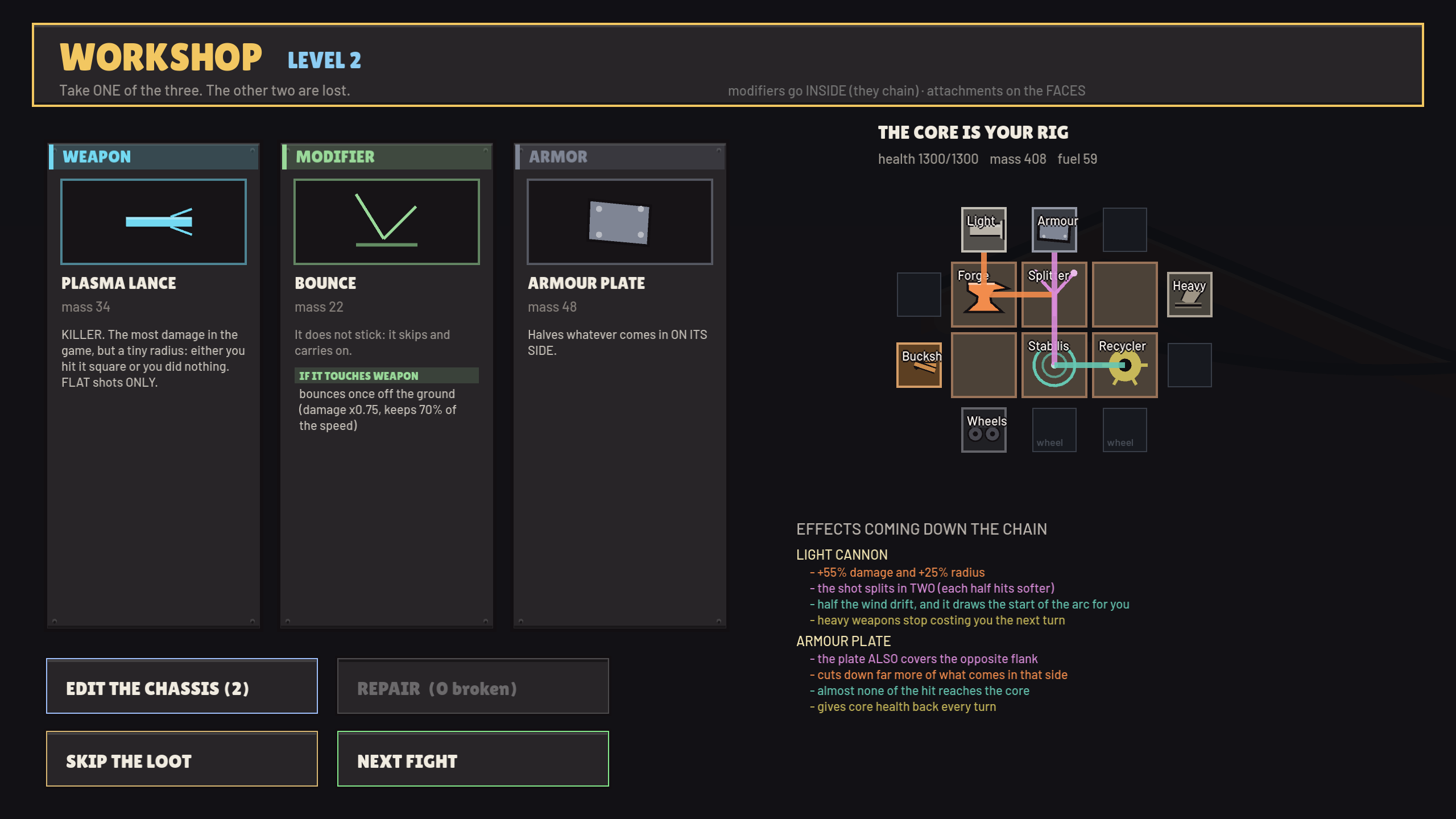
CHATARRA is a turn-based artillery roguelite. You do not upgrade a weapon: you build a machine. Your rig is a grid of cells you reshape every level. Modifiers go inside and chain into each other; weapons, armour and drive gear bolt onto the faces. What makes a part strong is not the part — it is where you put it.
A Splitter next to a cannon splits the shot in two. The same Splitter next to armour makes the plate cover both flanks. Move it one cell and it does something else entirely.
What you actually do
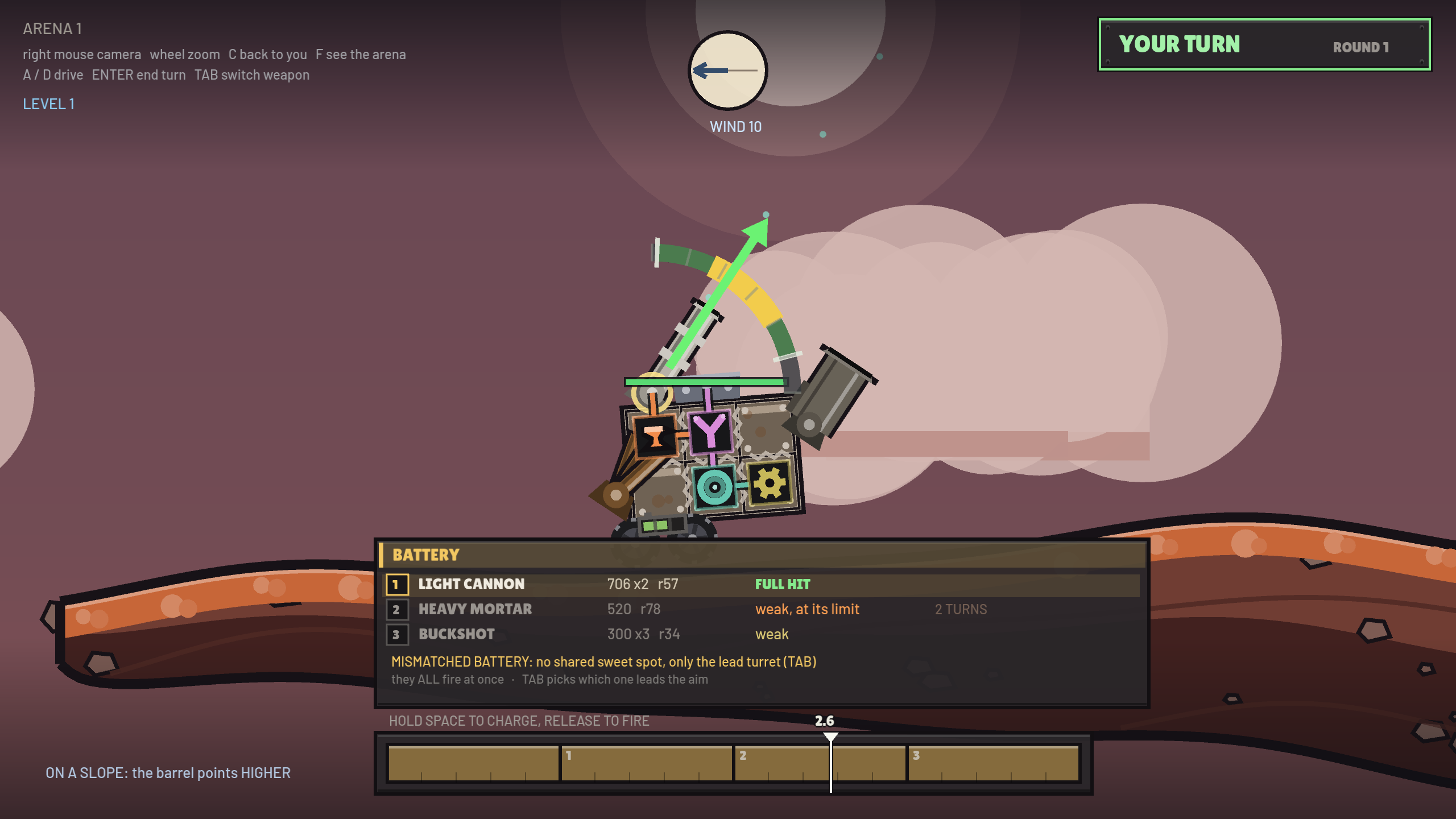
- Aim like it’s 1998. Angle and power. No trajectory line, no numbers on screen: you read the arrow against its arc, hold SPACE to charge, and correct from the craters you left last turn.
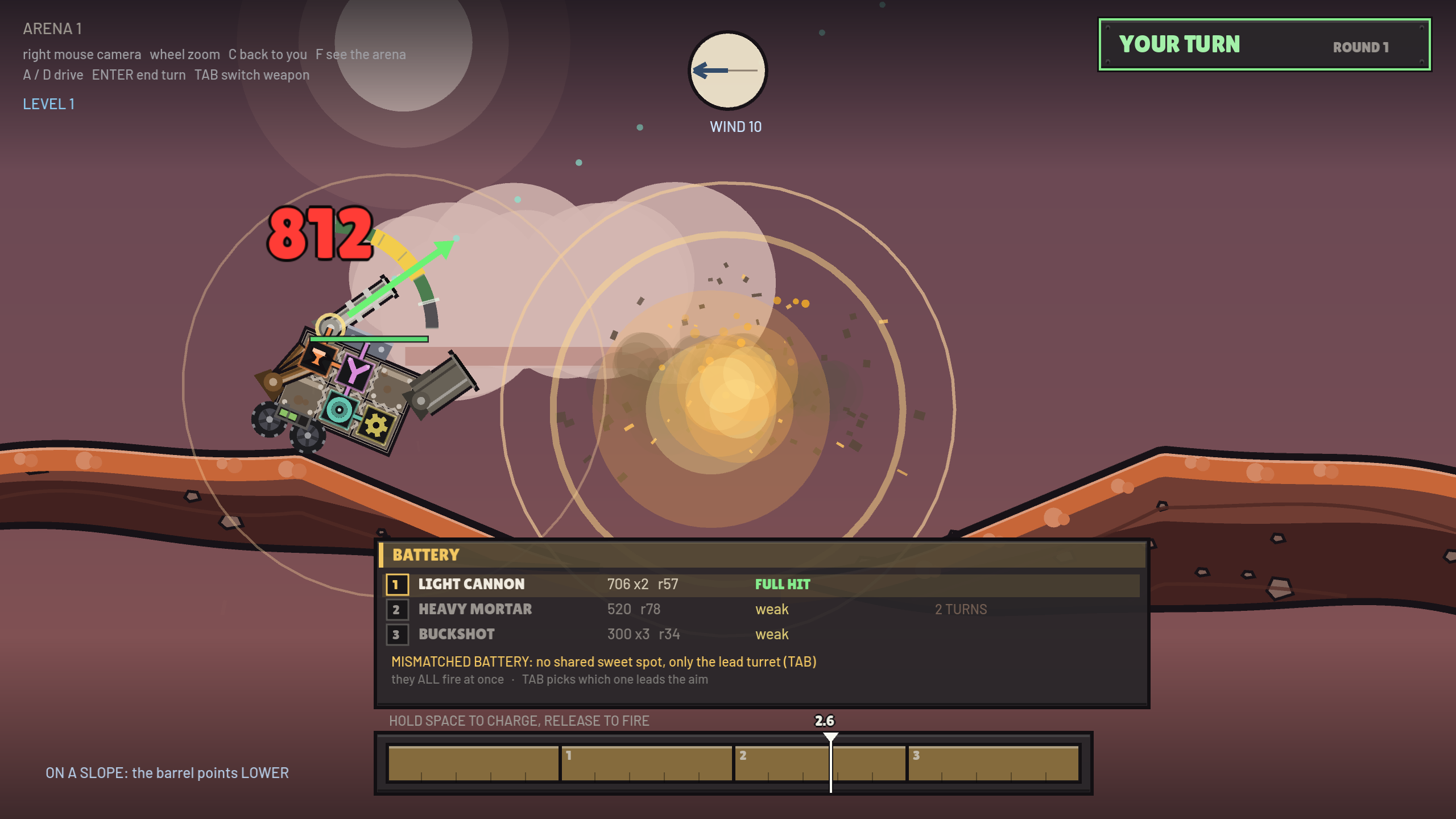
- The sweet spot is the play. Every battery has one narrow band of angles. Nail it and the whole salvo hits full and tears parts off the enemy. Miss it and the shot is weak and breaks nothing.
- All your turrets fire at once. Mount three and all three go, each clamped to its own angle band. The more you bolt on, the narrower your shared sweet spot — more damage, harder to land.
- Parts get disabled, not destroyed. A good hit rips off a turret, jams the tracks, or cuts a modifier chain in half. No wheels, no moving. No turrets, no firing. Repairing costs your turn — or your loot.
- The ground is thin and it kills. Every map floats and every map can be holed. Blowing the island out from under someone wins just as hard as cracking their core.
- One of three, then live with it. No shop, no gold, no rerolls. Take one part, lose the other two, and make it work with what you already welded on.
What’s in it
- 24 parts: 8 weapons with real jobs (the mortar is the only thing that eats an island; the cryo cannon freezes their drive gear so you know exactly where they will be), 3 defence and mobility pieces, and 13 modifiers that change the physics of your shells — gravity, drag, wind, bounce, piercing, fire, fragmentation.
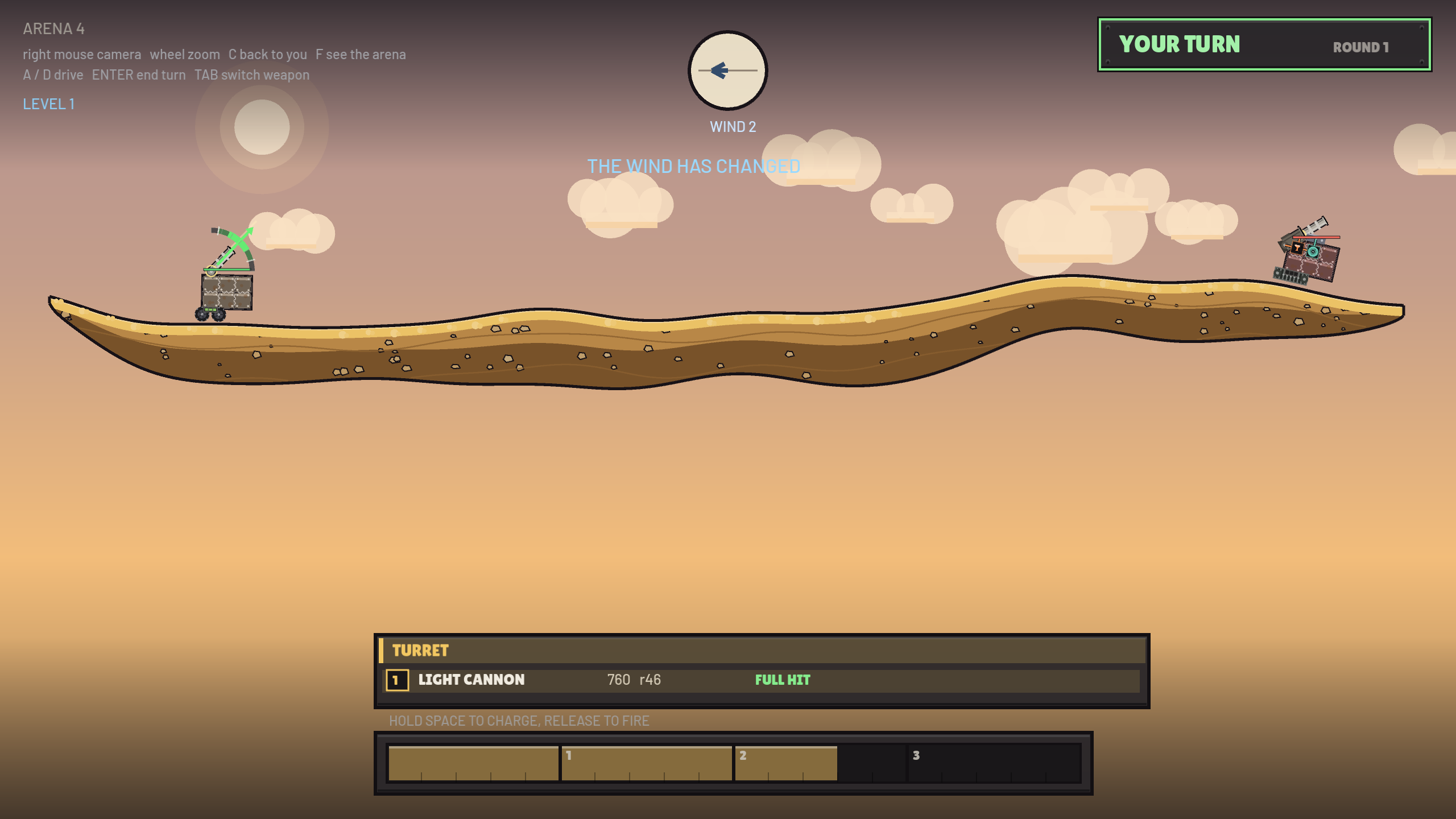
- 5 map shapes (two islands, bridge, archipelago, staircase, and one giant island with no gap at all) across 4 biomes, generated fresh every arena.
- Wind that changes between turns, sometimes flipping outright. The shot you had dialled in stops working.
- An enemy that ranges you in like a person: the first shot falls wide on purpose, and it corrects — sometimes overshooting past you — until it has your distance.
Controls
- A / D — drive
- W / S — aim (elevation)
- LEFT / RIGHT — turn to face the other way
- HOLD SPACE — charge power, release to fire
- TAB or 1-9 — pick which turret leads the aim
- R — repair a broken part (costs your turn)
- ENTER — end turn
- C / F / mouse wheel — camera: back to you, see the whole arena, zoom
- Right mouse — pan the camera
Everything you see and hear is generated in code. The terrain, the rigs, the explosions and all 17 sounds — there is not a single sprite or audio file in the build. A mortar sounds deeper than a cannon because the game hands the synthesiser its blast radius, not because it is a different file.
Made in Godot 4. Fonts: Lilita One and Barlow (SIL Open Font License).
Leave a comment
Log in with itch.io to leave a comment.